EDITOR Annie Chien|TRANSLATOR Aurora Lin|PHOTO Bonhams
書畫藝術自古以來即為中華文化的重要載體,不僅見於宮廷殿堂,更深植日常生活之中,從傳統春聯、店鋪招牌到典雅的居家佈置,皆可窺見其影響之深遠。此次我們特別邀請邦瀚斯(Bonhams)中國書畫部資深專家林子瓏,深入剖析書畫作為文化品味的演變脈絡,並展望當代收藏市場的未來趨勢。
Life’s Essence in Ink and Brush / Elevating Life Through Ink and Brush
Interview|Rex Lin, Bonhams’ Senior Specialist of Chinese Paintings Preface
For centuries, painting and calligraphy have stood as vital pillars of Chinese culture—gracing imperial halls while seamlessly weaving into daily life. From festive couplets and shopfront signage to refined home decor, their influence is deeply embedded in everyday life.
In this feature, we invite Rex Lin, Bonhams’ Senior Specialist of Chinese Paintings, to provide a profound perspective on the evolution of Chinese painting and calligraphy as expressions of cultural taste, and to share his observations on today’s collecting market.

書畫入世:文化美感的日常體現
「書畫從來不是遙不可及的藝術,它與生活共生共存。」林子瓏語帶堅定指出,從鼎泰豐招牌由于右任親題,到溥儒以紅紙濃墨書寫的〈壽〉字,書畫作品所傳遞的不僅是文字之美,更承載了祝福、禮儀與情感。

他舉例古代書法中常見的排版邏輯,如「國家」兩字往往被放大,以象徵國權高於個人,這些書寫與佈局方式,體現了文字背後的情感邏輯與價值排序。「以溥儒的〈居之安〉為例,若將『居』放大而『安』縮小,傳達出的意涵與心理投射將截然不同。」書法之所以動人,正是因其將思維與情感具象化為筆墨線條。
Art in Everyday Life: The Aesthetics of Cultural Living
“Painting and calligraphy are never meant to be aloof or inaccessible—they have always been deeply connected to everyday life,” Rex Lin emphasizes. From the iconic Din Tai Fung signage penned by Yu Youren to Pu Ru’s striking calligraphy of the Longevity character, rendered in bold ink on red paper, each work goes beyond the beauty of the script, carrying blessings, etiquette, and emotion.
Rex then discusses commonly observed layout principles in classical calligraphy. For example, the characters for “nation” (guo jia) are often enlarged to highlight the primacy of the state over the individual. These layout choices reflect the emotional logic and hierarchy of values embedded in the text. Take Pu Ru’s Peace in Living (居之安), for instance: enlarging the character for“Living” (居) while diminishing“Peace” (安) would completely alter the sentiment it conveys. The beauty of calligraphy lies in its ability to transform thought and emotion into tangible brushstrokes.

收藏的本質:精神與時間的層疊
對林子瓏而言,收藏是一種與作品共同生活的過程:「曾經擁有,在某種程度上已給予我們精神上的富足。」他深愛書信,因那是一代代文人情感與思想的真實流露。
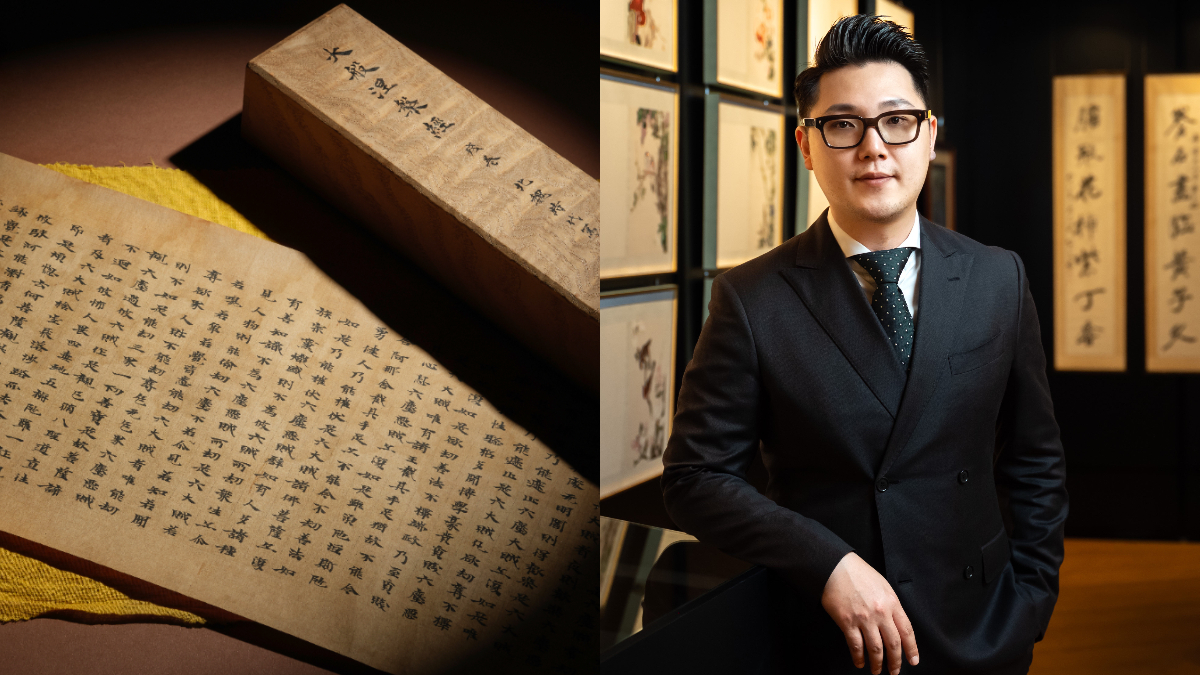
林子瓏分享一件最近在邦瀚斯上拍,令他印象深刻的作品——蔡守與談月色〈芙蓉盆銘硯拓本、雪浪石圖〉,原型來自蘇軾於被貶定州時發現的一塊奇石。蘇軾將石置於漢白玉雕盆中並刻詩於盆沿,即為「雪浪石盆銘」。此銘文後縮刻於硯台並傳拓,再得蔡守與談月色補繪雪浪石,並邀諸家題跋,成為一段跨越時空、融合詩書畫印的雅事,亦是文化傳承的見證。
The Essence of Collecting: Where Time and Spirituality Intertwined
To Rex Lin, collecting is not just about acquiring objects—it is about living with the work itself. “To have owned a piece, even briefly, is, in some sense, to have been spiritually enriched by it.” He has a particular fondness for handwritten letters, as they offer a genuine expression of the emotions and thoughts of literati across generations.
Rex introduces a remarkable work recently auctioned at Bonhams Hong Kong: A Rubbing of a Stone Inscription, a horizontal scroll inscribed and signed with ten collectors’ seals. The piece, created by Cai Shou and Tan Yuesè, traces its origins to a rare stone discovered by Su Shi during his exile in Dingzhou. Su placed the stone in a white jade basin and engraved poems along its rim. Over time, the stone inspired the creation of an inkstone, rubbings, and eventually a painting of its likeness by Cai and Tan. They also invited various collectors to create inscriptions on the work. This piece beautifully combines poetry, calligraphy, painting, and seals, transcending time and preserving cultural heritage.

新藏家世代:書畫走進當代語境
現今藝術市場正經歷世代交替的轉變,年輕藏家崛起,推動審美語言的更新與多元。林子瓏觀察到,現代藏家更重視「作品所傳遞的個人觀點與態度」,如同社群媒體上的hashtag,是個人風格與價值觀的視覺化展現。
他另以吳冠中為例,這位融合西方繪畫結構與中國水墨精神的大師,其作品〈大宅〉與〈秦淮河畔〉以簡約筆墨、大面積色塊建構東方意境,呈現介於傳統與現代之間的美學張力。這正符合當下年輕藏家對「簡潔、現代、富含精神意涵」的藝術偏好。
A New Generation of Collectors: Ink Art Reimagined for Today
As the art market transitions into a new era, a rising generation of collectors is reshaping and diversifying the language of aesthetics. Rex Lin notes that modern collectors are drawn not only to technique or tradition but also to “the personal perspective and attitude expressed through the work.”— much like social media hashtags, which transform values and style into a visual statement.
He also references the works of Wu Guanzhong, who masterfully blends Western compositional structures with the spirit of Chinese ink aesthetics, as exemplified in Qinhuai River and Big Mansion— works that employ broad colour blocks and minimalist brushwork to evoke an Eastern aesthetic. The works strike a delicate balance between tradition and modernity, perfectly resonating with young collectors’ tastes for simplicity, modernity, and spiritual depth.

書畫未來:深植語言的文化載體
「只要我們仍使用漢字與中文語言,書畫藝術便不會消逝。」林子瓏堅信,書畫不僅是一種視覺藝術,更是一種文化根性的體現,深植語言與情感之中。
他鼓勵新藏家「擇其所愛」,唯有真心喜愛,方能深入鑽研,進一步理解其中的文化脈絡與藝術層次,書畫不只裝點空間,更是內在修養的映照,當它成為日常生活的一部分,真正的美感才得以展現。
在林子瓏眼中,書畫藝術不僅是收藏品,是一種生活態度的延伸,是與時間對話、與文化共鳴的橋樑;筆墨之間,蘊藏的是不隨時間消逝的生活高度與文化深度。
The Future of Calligraphy and Painting: A Living Cultural Expression Rooted in Language
“So long as we continue writing in Chinese, calligraphy will endure,” Rex Lin affirms. More than just visual art, he sees calligraphy as a vessel of cultural identity, deeply intertwined with both language and emotion.
For those new to collecting, he offers a simple yet profound piece of advice: “Buy what you love.” True appreciation stems from heartfelt connection, which naturally inspires a deeper exploration of the work’s cultural context and artistic significance. Calligraphy and painting are far more than mere decoration—they are a reflection of one’s inner character. When beauty becomes part of daily life, it ceases to be a conscious pursuit and instead becomes a natural presence that surrounds you.
In Rex Lin’s eyes, calligraphy and painting are not merely collectibles—they are an extension of one’s approach to life, a dialogue with time, and a bridge to cultural resonance. Within the interplay of brush and ink lies a depth and richness of life and culture that endures beyond the passage of time.
發佈留言