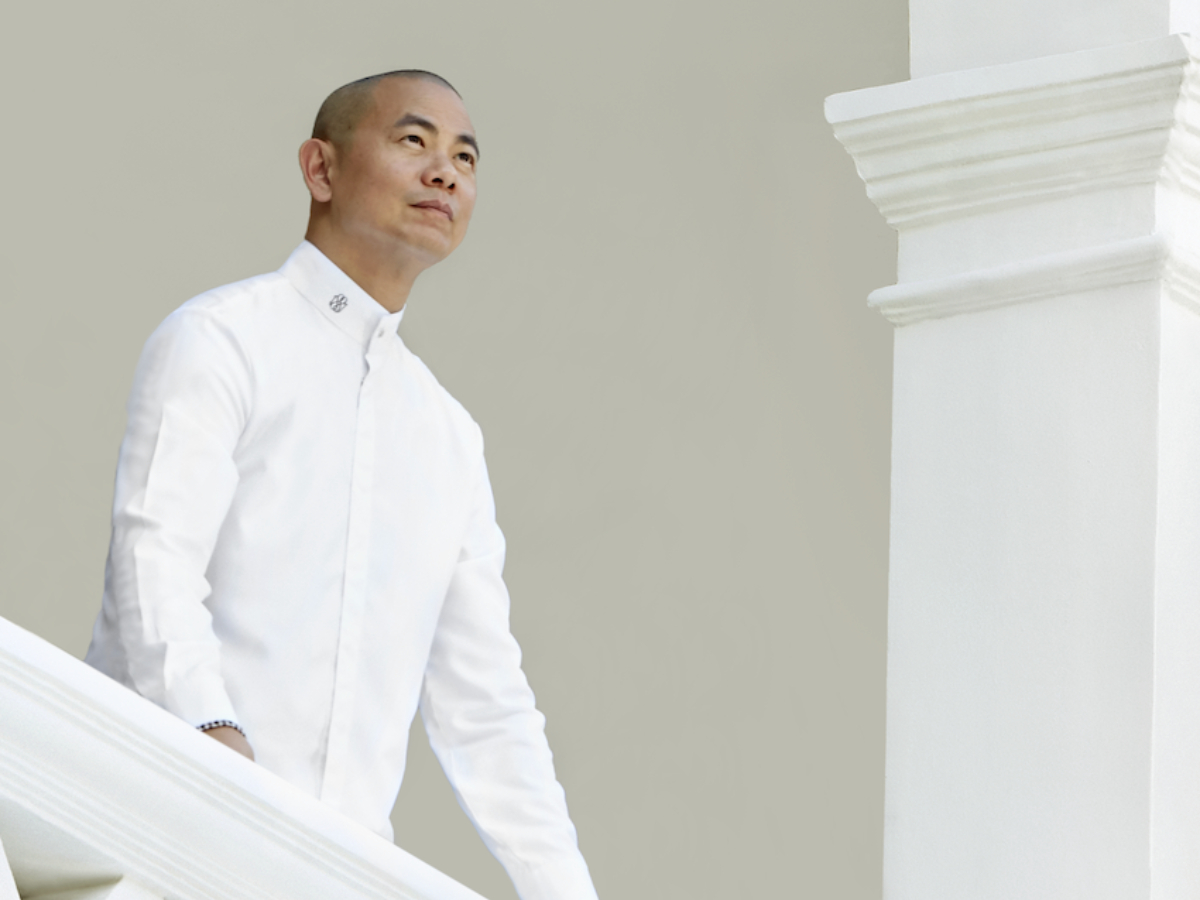
EDITOR 簡妤安 Annie Chien|TRANSLATOR Aurora Lin|ART DESIGN Mike Chiu|PHOTO Raffles Hotel Singapore
RAW 結束後,有些人好奇 Chef André 在做什麼?摯友們說,Chef André 似乎比以前更難約了。他在台灣規劃料理學院,在新加坡籌備擁有百年歷史的餐廳,在談亞洲料理人的位置與未來——江振誠退出第一線之後,卻好像哪裡都有他。Chef André 笑說,對啊,我是比以前更忙,因為視角不一樣了,能做的事也跟著變多了。
今年,邁入五十歲。這個數字對他來說,帶著某種清晰的重量。他說,五十歲這個階段,他想做的事都跟「給予」有關:給台灣一所料理學院,給新加坡一間值得再次被記住超越一百年的餐廳,給下一代一條他自己摸索過、踩穩過的路。
這次專訪,談到料理人的職業生涯,他用了運動員做比喻:巔峰期就那麼幾年,燃燒得再亮,總有熄滅的時候。所以他現在做的,是在火還旺的時候,去點亮下一個世代。這樣的 Chef André,和大眾印象裡那個站在精緻餐桌前、將亞洲料理帶上世界舞台的料理人,好像有些距離,又好像一脈相承。位置會改變,但那份真誠,永恆不滅。

Leaving a Seat at a Hundred-Year Table
André Chiang and the Next Decade
After RAW closed, people began to ask: what is Chef André doing now? Friends say he’s become harder to pin down. Not less active—just elsewhere. He’s building a culinary academy in Taiwan. Preparing a restaurant in Singapore meant to last a hundred years. Speaking about where Asian chefs stand—and where they’re going. He laughs. Yes, he’s busier now. The difference, he says, is perspective. When that shifts, what you’re able to do expands with it.
This year, he turns fifty. The number lands with weight. At this point, everything he wants to do comes back to giving. A culinary academy for Taiwan. A restaurant in Singapore that will outlast him. A path for the next generation—one he’s already walked. He compares a chef’s career to that of an athlete. There’s only a short window at the peak. No matter how brightly it burns, it doesn’t last. What matters now, he says, is what you do with what’s left.
This version of Chef André feels different from the one many remember—the chef at the pass, bringing Asian cuisine onto the global stage.
And yet, it isn’t a break. More a continuation. The position changes. The sincerity doesn’t.

TIMELESS, Chef André
「我定義我現在這個階段是,在為下一代開一條路,而不再是為我自己。」這句話,Chef André 說得很平靜,但對一個在國際餐飲圈已經有名字、有位置的料理人來說,選擇把舞台讓出去,需要的遠不止於謙遜。
他說,退出第一線這個決定,有很大一部分是為了團隊。跟了他多年的人,都到了需要往下一個階段走的時間點,如果他繼續站在最前面,他們就沒有機會獨當一面。外界以為他退場是一種選擇,他卻說,恰恰相反,現在的感覺更像責任。過去在第一線,他對一間餐廳的品質負責,對每一道上桌的菜負責。現在他的責任更難量化:那些累積了幾十年的判斷與眼光,那些關於亞洲料理人應該如何被看待的論述,那些還沒整理好、還沒傳遞出去的知識,要以什麼樣的形式留下來。他說,如果什麼都不做,André 就會消失。那個「消失」,不是名氣,是那些珍貴的意志與風格。
這也是為什麼他同時在推進兩件事——台灣的料理學院,以及新加坡萊佛士酒店(Raffles Hotel)的1887 by André。兩件事的出發點都一樣:替這個產業留下一些比他自己更長久的東西。他說他想做的是「timeless」的事,不是流行,不是話題,是一種能夠持續影響人的存在,十年後在,二十年後還在。
TIMELESS, Chef André
“This stage, for me, is about opening a path for the next generation.”
“Not for myself.” He says it plainly. But for someone who has already secured his place in the global dining world, stepping back takes more than humility.
Part of that decision, he explains, was for his team. Many of those who have worked alongside him for years have reached a point where they need to move forward. If he stayed at the front, they wouldn’t. From the outside, it looks like stepping away.
To him, it feels like responsibility. Before, he was responsible for a restaurant—for every plate that left the kitchen. Now, it’s harder to define. Years of accumulated judgment. A way of seeing. Ideas about how Asian chefs should be understood. Knowledge not yet fully shaped, not yet passed on. “André will disappear,” he says. Not the name. But everything behind it.
That’s why he’s working on two things at once. A culinary academy in Taiwan. And 1887 by André at Raffles Hotel Singapore. The intention is the same. To leave behind something that lasts longer than he does. He calls it timeless. Not trend. Not moment. Something that stays. Ten years from now. Twenty.
WE HAD THE BEST TIME TOGETHER
「We had the best time together. 」這是 Chef André 最想在 1887 by André 這封「情書」裡留下的一句話,訴說的對象,是新加坡,也是 Raffles Hotel。這段源自二十多年前的緣分,中間有過合作、出過書,Raffles Hotel 也一直希望他能在這裡做一間餐廳。他一直說不——他說他不想只是又開一間「André 的新餐廳」。
他對 1887 by André 的構想,是把一間從百年前就存在的餐廳重新開回來,並繼續傳承一百年。這個想法,Raffles Hotel 接受了,因此,1887 by André 成為 Chef André 在五十歲這個階段,送給新加坡的禮物。這座城市是他回到亞洲後真正站穩腳步的地方,在這裡待了數十年,見過它的璀璨,也深深參與過其中的一段,就如同一封情書。
情書這個比喻,他給了十分有意思的解釋。他說,情書裡的那段關係,未必是相伴走到最後的人,但往往是這一輩子記得最深的一段。新加坡這段,有 Chef André 與這個城市之間的重量,也有他在此深耕多年的濃度。那段歲月,他覺得是新加坡餐飲最發光的時候,而現在這間 1887 by André,傳承了他寫下的那句:我們曾經共度最好的時光。這樣的出發點,點出了 1887 by André 這間餐廳的性格,不是江振誠的個人舞台,是新加坡這座城市飲食記憶的總和。
WE HAD THE BEST TIME TOGETHER
“We had the best time together.” That’s the line he wants to leave behind. A love letter—to Singapore. To Raffles Hotel. Their connection goes back more than two decades. There were collaborations, a book, and repeated invitations to open a restaurant there. He always said no.
He didn’t want to open just another “new André restaurant.” What he imagined instead was something else entirely: to reopen a restaurant that existed over a century ago—and let it continue for another hundred years. Raffles said yes.
At fifty, 1887 by André becomes his gift to Singapore. It’s the city where he found his footing after returning to Asia. Decades spent there. A shared history. Something personal. Like a letter. He has his own way of explaining that. The relationship you write about in a love letter isn’t always the one that lasts. But it’s often the one you remember most.
Singapore holds that place. There’s weight in it. And years of something built, layer by layer. A time he still sees as one of the brightest moments in the city’s dining scene. And now, in 1887 by André, that line remains: We had the best time together. This isn’t a personal stage. It’s a collective memory of the city itself.

1887 by André,三個世代的總和
Chef André 描述自己在 1887 by André 扮演的角色,用了一個不太像料理人的詞:考古。在這間餐廳,他有一半的工作是考古——把那些沉在歷史裡的菜色、那個年代的飲食邏輯、那些沒有食譜但有脈絡可循的味道,從 1887 年一件一件往後翻,試圖理解那個年代的美味。
1887 年是英國維多利亞時代,那個時代的新加坡餐桌有很強的儀式感。À la carte(單點菜單)的盛行,意味著用餐者有了自由選擇的權利;桌邊服務、繁複的禮儀,讓一頓飯成為一種社交表演。Chef André 回顧那個年代的料理,是對古典菜譜的精準執行,所有東西都有所本、引經據典,找回那些菜色,對他來說並不是最難的事。真正難的,是如何讓過去和現在同時存在。
1887 by André 的料理,疊進了三個世代的新加坡:1887 年英屬時期的古典菜色、馬來西亞時期的在地風味、以及新加坡獨立後六十年發展出來的飲食語言。他說,這張菜單不是復刻,不是懷舊,是 A+B+C=D——三個世代加在一起,成為一個只有在這裡、只有在這個時間點才能出現的總和。他特別說,不會刻意在 1887 by André 留下「André的風格」,而 Restaurant André 在新加坡的歲月,當然也是這座城市飲食史的一部分,菜單裡也會找到 Restaurant André 的位置。不管是在地居民還是旅人,都能從 1887 by André 找到這座城市走過的歷史。這樣的態度,放在一個已經建立起個人風格與國際聲譽的料理人身上,有一種反直覺的清醒。
1887 by André
A Convergence of Three Generations
He uses a word that doesn’t sound like it belongs in a kitchen: archaeology. Half of what he does here, he says, is exactly that. Dishes buried in history. Dining logic from another time. Flavors without written recipes, but still traceable. He goes back to 1887—piece by piece—trying to understand what defined taste then.
Singapore in 1887, under British rule, carried a strong sense of ritual. À la carte meant choice. Table-side service, formal etiquette—dining was performance. Reconstructing those dishes isn’t the hardest part. The challenge is letting past and present exist at the same time.
The menu at 1887 by André layers three generations of Singapore: The colonial era. The Malaysian period. And the decades after independence. This isn’t reconstruction. Not nostalgia. A + B + C = D. Three timelines, combined into something that can only exist here—and now.
He makes one thing clear. There’s no intention to impose “André’s style.” And yet, Restaurant André—his own past in Singapore—is part of the city’s culinary history. It finds its place here too. Whether you’re local or just passing through, the menu holds a version of the city. From a chef known for a strong personal voice, the approach feels almost counterintuitive. But also, precise.

教育,是給下一代最珍貴的料理
談到未來,Chef André 展現了對「教育」的熱忱。不管是料理學院、1887 by André,還是他持續參與的各種對話與計畫,最終指向的都是同一件事——把知識、把這個產業的可能性,傳遞給還在路上的人。
他希望教育能成為亞洲餐飲真正的影響力,幫助料理人這個角色在社會上建立起應有的位置與尊嚴。從前,亞洲的料理人看著歐洲的大師,往往覺得那是遙不可及的距離,但現在,身為一個亞洲的料理人,你可以有自己的話語權,可以站上世界舞台,可以傳承百年。
當一個料理人不只把自己當料理人,當他的影響力開始觸及人們對食物、對這個職業、對飲食文化的看法,那份價值讓人看得更遠,影響力的形狀,也可以遠比一張菜單、一間餐廳更寬廣:「我希望大家記得的,是亞洲料理人的韌性和創造力,是可以和世界平起平坐,甚至超越。我也希望大家記得,這個角色,是可以很有尊嚴地存在在這個產業裡。」Chef André 用五十年的時間走到這裡,也照亮更多料理人與深愛料理的人繼續前進。
Education as the Most Lasting Offering
When he talks about the future, it always comes back to one thing: education. The academy.
1887 by André. Ongoing conversations. Different forms, same direction. Passing on knowledge. Expanding what’s possible for those still on the path. He hopes education becomes a defining force in Asian gastronomy.
Something that gives chefs a place—and dignity—within society. There was a time when Asian chefs looked to Europe and saw distance. Now, he says, that distance doesn’t have to exist. An Asian chef can have a voice. Stand on a global stage. Build something that lasts a hundred years.
When a chef moves beyond cooking—when their influence shapes how people see food, the profession, the culture—everything changes. “I hope people remember the resilience and creativity of Asian chefs,” he says. “That we can stand alongside the world—or go beyond it.
And that this role can exist with dignity.” Fifty years brought him here. From here, he turns outward. Lighting the way—for chefs, and for anyone who still believes in what food can become.
發佈留言