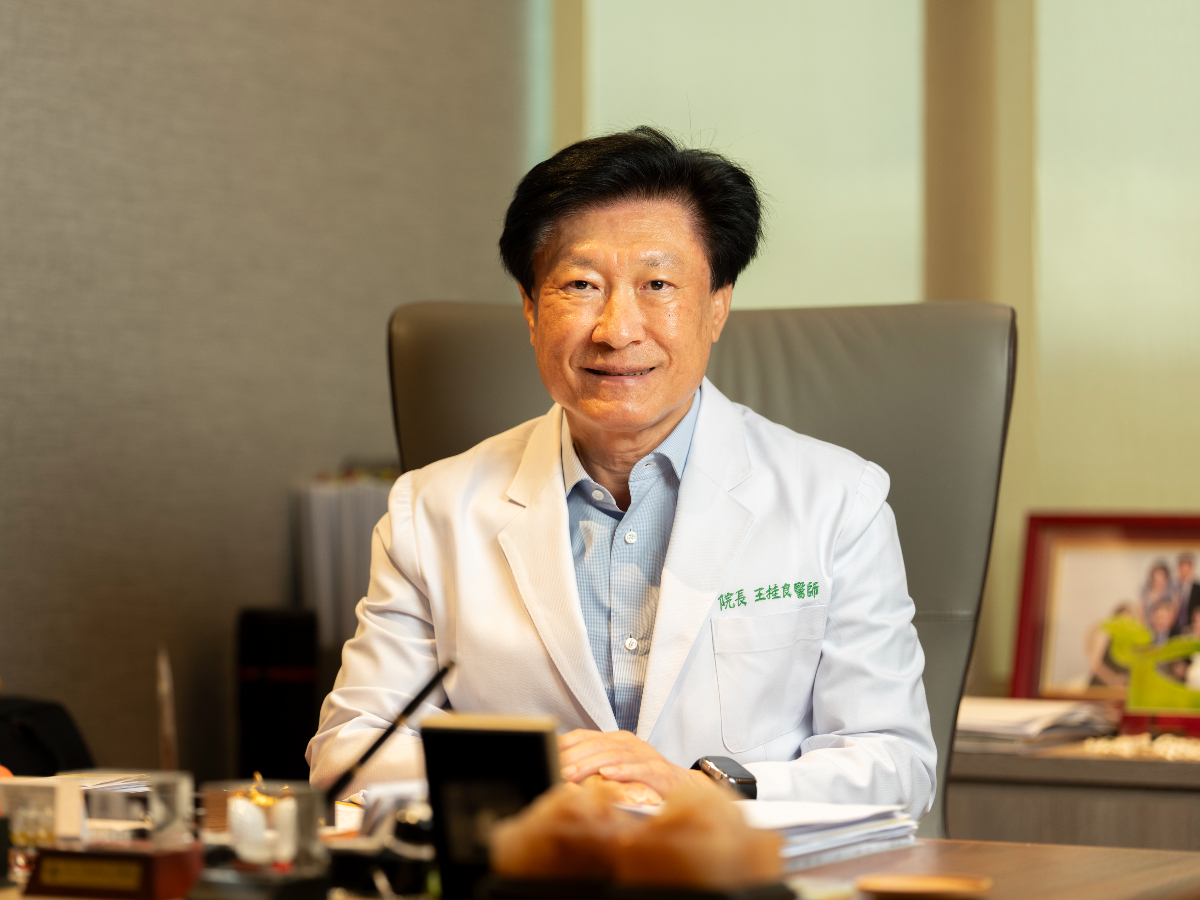
EDITOR 簡妤安 Annie Chien|TRANSLATOR Aurora Lin|PHOTOGRAPHER Leon Hung|LOCATION 安法診所(Anfa Clinic)
在台北林蔭大道敦化南路上,安法診所沒有掛號長龍,卻是許多企業主口耳相傳的健康秘境。創辦人暨院長王桂良身兼美國與世界抗衰老醫學會亞洲區首席專家醫師,並擔任台灣抗衰老及再生醫學會榮譽理事長,早在千禧年之初的報導中,就已是胡定吾、辜仲諒等重量級企業家尋求健康管理時的首選醫師,彼此維持著數十年的信任。自1994年安法在此掛牌至今,這條路已經走了三十二個年頭。訪談當天,已滿72歲、步入73歲的王院長,精神奕奕、談鋒甚健,大健康話題橫跨基因、細胞、賀爾蒙與未來科技,字字句句帶著深耕數十年的篤定。辦公桌旁掛著一方客人所贈的匾額,寫著「王者聚德利生,桂冠眾望所祈,良醫妙手回春」,短短十八字,成了外界給王院長最貼切的註腳。
A Life in the Pursuit of Longevity
Kuei-Liang Wang, Founder and Director of Anfa Clinic
Along the tree-lined expanse of Dunhua South Road in Taipei, Anfa Clinic is a discreet presence. There are no long queues at reception, yet among business leaders, it has long been a trusted address for health management, passed quietly from one acquaintance to another. Its founder and director, Dr. Kuei-Liang Wang, is Chief Medical Expert for Asia at the American Academy of Anti-Aging Medicine and the World Academy of Anti-Aging Medicine, as well as Honorary Chairman of the Taiwan Academy of Anti-Aging and Regenerative Medicine. As early as the turn of the millennium, media reports had already identified him as a physician trusted by prominent business figures including Hu Ding-wu and Jeffrey Koo Jr.—relationships that have since endured for decades.
Thirty-two years have passed since Anfa Clinic first opened its doors here in 1994. Now 72 and approaching 73, Dr. Wang remains remarkably energetic and engaging. Our conversation ranges effortlessly across genetics, cellular science, hormones and emerging technologies, every observation carrying the quiet assurance of more than four decades devoted to the field. Beside his desk hangs a plaque presented to him by a patient. Its eighteen Chinese characters form an acrostic around his name, praising a man whose virtue benefits others, whose distinction commands admiration, and whose healing hands restore the springtime of life. Few tributes could better capture the esteem in which Dr. Wang is held.

青春有解
三十二年前,王院長還是長庚醫院的小兒外科醫師,前往哥倫比亞大學附設醫院進修時,友人提起一段往事:一位相交多年的摯友因劇烈腹痛送醫,因長年飲食失衡引發急性壞死性胰臟炎,最終無法開刀、沒能救回。這段經歷讓他反覆思考:若醫學能事先介入提醒,結果是否會不同?返台後,他籌劃開設診所,將兩三天的健檢流程濃縮為當天早上檢查、下午拿報告;隨後遠赴巴黎,與法國抗衰老醫療機構合作。
看著七、八十歲的當地人打扮得體、開著車優雅赴診,這幅畫面成為「安法」的由來。此後多年,他持續參與國際抗衰老會議,逐步建立基因檢測與實驗設備。2009年,安法成立細胞實驗室並取得國際認證;2012年,英國學者John Gurdon與日本學者山中伸彌因再生醫學的開創性貢獻獲得諾貝爾醫學獎;2014年,他便將存放多年的細胞送往史丹佛大學進行技術驗證,後續更與劍橋大學正式簽約合作、投入研究。紐約、巴黎、史丹佛、劍橋,他始終與國際醫學研究接軌,讓安法的腳步與世界同步。
Decoding Youth
Thirty-two years ago, Dr. Wang was a pediatric surgeon at Chang Gung Memorial Hospital. While undertaking further training at Columbia University Medical Center, he heard from a friend about a tragedy that would remain with him. A close friend of many years had been rushed to hospital with severe abdominal pain. Years of dietary imbalance had led to acute necrotizing pancreatitis; by the time the condition was diagnosed, surgery was no longer an option, and his life could not be saved. The story left Dr. Wang returning to the same question: if medicine had intervened earlier—if there had been a chance to recognize the warning signs in advance—might the outcome have been different? After returning to Taiwan, he began planning his own clinic around the idea of earlier intervention and more efficient health management. A physical examination process that once took two or three days was condensed into a single day, with tests performed in the morning and reports available that afternoon. He later travelled to Paris to collaborate with a French institution specializing in anti-aging medicine.
There, the sight of people in their seventies and eighties arriving for appointments impeccably dressed and driving themselves with effortless independence left a lasting impression. It was this vision of aging with vitality and grace that helped inspire Anfa. Over the years, Dr. Wang continued to attend international conferences on anti-aging medicine while steadily developing the clinic’s genetic testing capabilities and laboratory facilities. In 2009, Anfa established a cell laboratory and obtained international accreditation. Three years later, British scientist John Gurdon and Japanese scientist Shinya Yamanaka were awarded the Nobel Prize in Physiology or Medicine for discoveries that opened new possibilities in regenerative medicine. By 2014, Dr. Wang had sent cells preserved for years to Stanford University for technical validation, later entering into a formal research collaboration with the University of Cambridge. New York, Paris, Stanford, Cambridge—throughout his career, Dr. Wang has remained closely connected to developments in international medical research, ensuring that Anfa continues to move in step with the wider world.

桂冠不老
老祖宗常說「呷百二」,王院長解釋,人體細胞平均分裂24次,每次週期約五年,累加起來正好是120歲,這是基因寫好的潛力,但多數人卻死於疾病,原因在於現代生活與遠古基因之間的落差:污染、飲食型態改變,以及日益累積的慢性壓力,都是老祖宗未曾遇過的挑戰。他常提醒,人有七成的基因表現可以透過後天調整:「就像教養孩子,同樣的先天條件,對待方式不同,結果大不相同;也像照顧一座花園,土壤若受污染,得先找出缺了什麼、對症調整,才能持續盛開。」
落實到日常,他每天回家第一件事就是站上體重計,起床空腹時再量一次,數字有異常就立刻調整飲食;食材講究當季、清洗徹底,烹調偏好低溫方式,份量拿捏上也遵循低胰島素飲食的原則;睡眠靠智能手錶記錄深睡比例;打高爾夫球時能走路就不搭車,讓自己有更多機會曬太陽,他常舉陽光稀少的西雅圖為例,說明日照不足與憂鬱、骨質疏鬆之間的關聯。這些看似瑣碎的堅持,累積起來就是讓身體「能量滿格」的關鍵。
Longevity by Design
There is an old Chinese blessing that wishes someone a life of 120 years. Dr. Wang sees a biological logic behind the saying. As he explains it, human cells undergo an average of 24 cycles of division, with each cycle corresponding to roughly five years, suggesting a potential lifespan of 120 years—a possibility he believes is written into our genes. Yet most people never reach that potential, he says, because disease intervenes. One reason, in his view, is the growing mismatch between our ancient genetic inheritance and the conditions of modern life. Pollution, changing dietary patterns and the cumulative burden of chronic stress all present challenges our ancestors never had to contend with.
Dr. Wang often tells his patients that as much as 70 percent of gene expression can be influenced by environmental and lifestyle factors. “It is like raising children,” he says. “Even with similar innate qualities, the way they are nurtured can lead to very different outcomes. Or think of the body as a garden. If the soil has been contaminated, you first have to understand what is lacking and make the right adjustments before it can continue to flourish.”
He applies this philosophy to his own life with unwavering consistency. The first thing he does when he arrives home each day is step onto the scale; he weighs himself again the following morning on an empty stomach. If the numbers shift unexpectedly, he adjusts his diet at once. He favors seasonal ingredients, washes them thoroughly and prefers low-temperature cooking, while regulating portion sizes according to the principles of a low-insulin diet. A smartwatch tracks the proportion of deep sleep he gets each night. On the golf course, he walks whenever possible rather than taking a cart, creating more opportunities to spend time in the sun. He often cites Seattle, with its comparatively limited sunlight, when discussing the associations between insufficient sun exposure, depression and osteoporosis. Individually, these habits may seem almost inconsequential. Practised consistently, however, they become what Dr. Wang considers essential to keeping the body’s reserves of energy fully replenished.

花園常青
十多年前,王院長將安法拓展至上海,長年往返兩岸看診,他觀察到有趣的差異:大陸客人來自各方,包含北京、蘇州、杭州、深圳等地,靠口碑相傳而來,對醫囑的遵從度更高,一旦被提醒健康警訊,多半謹記在心;台灣則常是先生帶太太、太太帶先生,如今安法已服務到第三代。談到未來,他認為健康管理的重點正從器官、細胞,走向更精微的「感知系統」,理解營養如何在細胞內運作。
投入這個領域超過四十年,他始終相信,人類活到120歲並非不可能,甚至200歲,也充滿可能性。採訪尾聲,環顧王院長的辦公室,乾隆洋彩、東西方藝術品錯落其間,透露出對美的講究與生活的熱情。不老,或許正是像王院長這樣,數十年如一日,對生命保有一份由衷的熱忱。
An Evergreen Garden
More than a decade ago, Dr. Wang expanded Anfa to Shanghai and began travelling regularly between Taiwan and mainland China to see patients. Over the years, he has observed an intriguing difference between the two. His patients in mainland China come from across the country—including Beijing, Suzhou, Hangzhou and Shenzhen—many finding their way to Anfa through word of mouth. He has found them particularly diligent in following medical advice: once alerted to a potential health concern, most take the warning seriously and keep it firmly in mind. In Taiwan, by contrast, the connection often grows through the family: a husband brings his wife, or a wife brings her husband. Today, some families have been coming to Anfa for three generations. Looking ahead, Dr. Wang believes health management is evolving beyond the level of organs and cells toward what he describes as increasingly refined “sensing systems”—an effort to understand more precisely how nutrients are detected, processed and utilized within cells.
After more than forty years in the field, his belief in the possibilities of human longevity remains undiminished. Living to 120, he maintains, is not beyond the realm of possibility. Even a lifespan of 200 years, in his view, may one day become conceivable. As our conversation draws to a close, a glance around Dr. Wang’s office reveals another dimension of the man himself. Qianlong-period famille rose porcelain sits among works of Eastern and Western art, quietly reflecting both a discerning eye for beauty and an enduring enthusiasm for life.
Perhaps longevity, in the end, is about more than simply resisting the passage of time. In Dr. Wang’s case, it is found in something he has sustained for decades: an abiding curiosity about life, the discipline to care for it, and, above all, a genuine passion for living.
王桂良 安法診所創辦人暨院長
現職:
安法抗衰老醫療集團創辦人
醫新生命科學創辦人
安法診所創辦人/院長
專業證照與學會:
美國抗衰老醫學會(A4M)亞洲區首席專家醫師
世界抗衰老醫學會(WAAAM)亞洲區首席專家醫師
台灣抗衰老及再生醫學會(T3ARM)榮譽理事長
世界抗衰老醫學會(WAAAM)榮譽諮詢委員
著作與譯作:
2017年 《做基因的智者》
2014年 《我60,比你40更年輕!》
2005年 《會減肥的DNA》
2003年 《別把吃毒當吃補》
2002年 《別讓歲月催你老》
1999年 《自然荷爾蒙療法》
1999年 《脂肪為聰明之本》
1999年 《自然治療健康法》
1999年 《解毒為健康之鑰》
1995年 《四十不老》
1995年 《活得更好更長久》
學經歷:
澳門科技大學客座教授
長庚兒童醫院外科主任
長庚大學醫學院副教授
美國哥倫比亞大學紐約長老教會醫院小兒外科臨床研究員
美國長島猶太醫學中心小兒外科臨床研究員
長庚紀念醫院小兒外科主治醫師
高雄醫學大學醫學系醫學士
發佈留言